
Erica Rodriguez '19 Works for Department of Homeland Security in California Alumni Profile
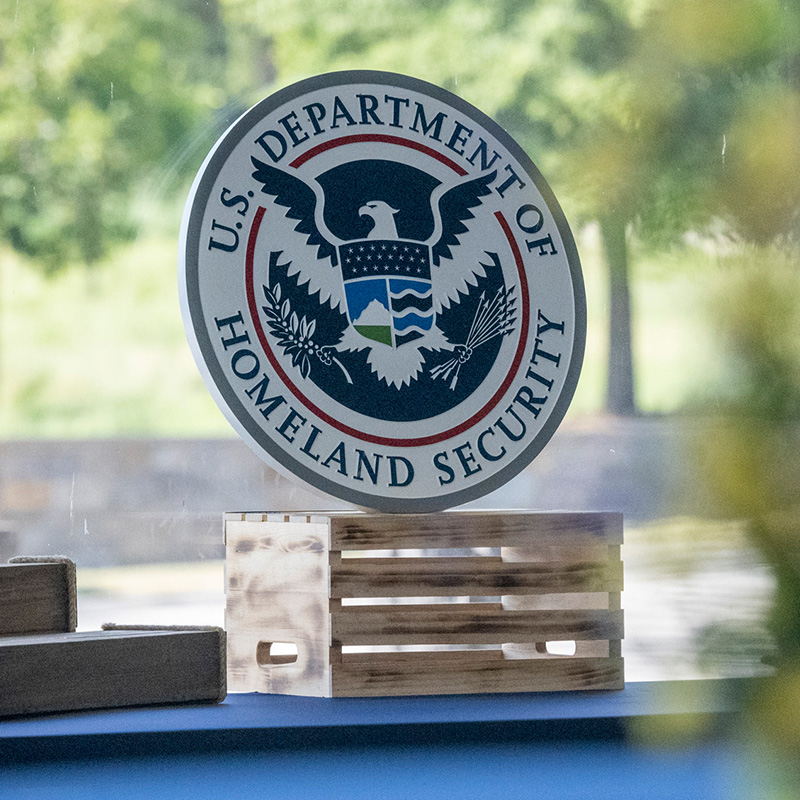
Pictured is the Department of Homeland Security logo. At the request of the federal agency, photos of this alumna have not been shared to protect her safety and identity.
Meet Erica Rodriguez
- Job Title & Employer
- Federal Law Enforcement Officer, U.S. Customs and Border Protection
- Major/Program
- Intelligence and National Security-traditional/certificate
- Graduation
- 2019
- College Activities
- Order of the Sword & Shield Honor Society, Counterterrorism Research Intern at the Institute of World Politics in Washington, D.C.
- Hometown
- Kingwood, Tx.
- High School
- Kingwood High School
- Now Living In
- San Diego, Calif.
- Hobbies & Interests
Working out, hiking among San Diego’s beautiful trails, walking or running with my dog Milo and exploring new coffee shops.
"For students who are analytical, curious and motivated by service, intelligence studies provides a challenging yet rewarding path with diverse career opportunities across multiple agencies and disciplines."
How did Point Park’s intelligence and national security program help prepare you for your career?
Point Park University’s intelligence studies program played a critical role in preparing me for a career in intelligence and national security. The program emphasized analytical rigor, critical thinking and clear communication skills that are foundational to intelligence work. Some of the courses challenged students to think beyond surface-level analysis and apply structured analytic techniques to real-world scenarios, which closely mirrors the expectations of the professional intelligence environment.
Faculty mentorship was one of the most impactful aspects of the program. Professors, particularly Mark Wintz, Ph.D., created a classroom environment that balanced intellectual challenges with genuine support. Instruction extended beyond lectures, incorporating thoughtful feedback, meaningful discussion and individualized guidance. This approach not only strengthened my understanding of the subject matter but also helped me develop confidence in my analytical judgement and writing. The emphasis on applying intelligence concepts to practical situations prepared me to transition smoothly into a professional role where accuracy, clarity and critical thinking are essential.
Tell us more about your current role and responsibilities. What does a 'day in the job' look like?
As a Customs and Border Protection (CBP) Officer, we are responsible for securing our nation’s borders and preventing drug smuggling while enforcing immigration laws, protecting agriculture and facilitating lawful trade and travel. I am stationed at the San Ysidro Port of Entry, which is located on the southern border of San Diego, Calif. I inspect and process individuals, vehicles, and cargo entering or leaving the United States. This includes checking travel documents, verifying various visa types and conducting thorough inspections of goods to prevent illegal imports and exports. We process up to 70,000 vehicles and 20,000 pedestrians daily, and that is just the San Ysidro Port of Entry alone.
What made you want to join the Department of Homeland Security? Is the Border Protection portion of the agency something that interested you as a student?
I joined the Department of Homeland Security (DHS) as a stepping stone to get my foot into the federal government. I have always been interested in intelligence work, and DHS provided an opportunity to align my academic background with meaningful service. Growing up in a border region myself, I understood the importance and complexity of safeguarding our ports of entry and national boundaries. I was drawn to the operational aspect of the mission and how intelligence and enforcement work together in real time. I was also inspired by my father, who has served as a CBP Officer for over 30 years. His dedication to service and strong sense of integrity greatly influenced my decision to pursue this path.
What is the experience like moving from the classroom to a career? What advice would you give to current students following your path?
Transitioning from the classroom to a career in federal service was both exciting and humbling. In class, you learn theories, policies and the historical context behind national security and intelligence work. Once you enter the field, you quickly realize how dynamic and fast-paced the real world is. The stakes are higher, and the decisions you contribute to can have real impacts.
My advice to current students is to take your academics seriously but also seek practical experience; internships, networking, mentorship and developing strong writing and analytical skills are crucial. Be adaptable and open to starting in roles that may serve as stepping stones. Every assignment teaches you something valuable. Most importantly, maintain integrity and professionalism; those qualities will carry you far in this field.
Why should students be interested in pursuing a career in intelligence studies?
A career in intelligence studies is both meaningful and impactful. It offers the opportunity to contribute directly to national security and public safety. Intelligence professionals play a critical role in identifying threats, analyzing complex global issues and supporting informed decision-making at the highest levels. It is also a field that is constantly evolving. You are always learning, whether it’s about emerging technologies, geopolitical developments or new security challenges. For students who are analytical, curious and motivated by service, intelligence studies provides a challenging yet rewarding path with diverse career opportunities across multiple agencies and disciplines.
Is there anything else you would like to add?
I would encourage students to remember that a career in this field is about service above self. It requires dedication and resilience and a strong moral compass. While the work can be demanding, it is incredibly fulfilling to know you are contributing to something greater than yourself. Stay patient with the process, trust your preparation and don’t be discouraged by setbacks. Every experience helps shape you into a stronger professional.