

Faculty Q&A: Britney Brinkman, Ph.D., Combines Community-Based Psychology and Advocacy in the Classroom Monday, April 27, 2026
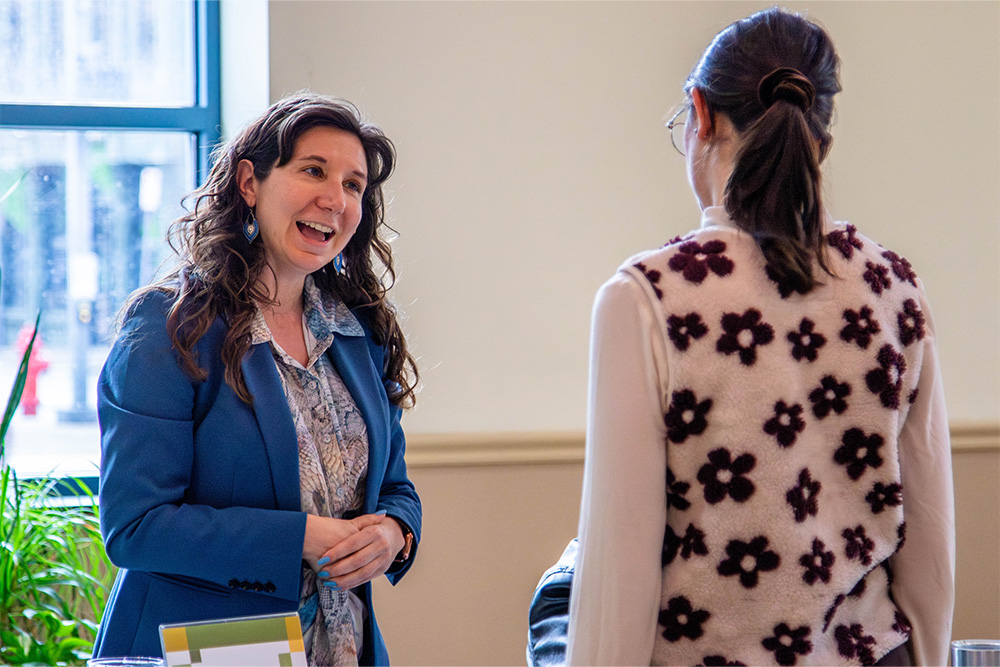
Britney Brinkman, Ph.D., speaks to a student at a recent Graduate Program Fair in Point Park University's Lawrence Hall.
When studying psychology at Point Park University, students will learn a wealth of information from Britney Brinkman, Ph.D., professor of psychology and director of clinical training. With an impressive record of clinical work and community-based practice, Brinkman helps guide students toward careers focused on helping their communities thrive and grow.
In the Q&A and video below, Brinkman helps highlight what sets Point Park's future psychologists apart from their peers and why students should choose the university on their paths to helping others.
What do you like to do for fun in Pittsburgh?
For fun in Pittsburgh, I love spending time in the outdoors, hiking and enjoying nature. We have many amazing parks here in the city and the surrounding areas. I spend a lot of time there. I also really love creating art. I do mixed media and glass art and I've taken classes at various centers. I'm taking a special effects glass-fusing class at the Pittsburgh Glass Center, which is really fun.
How does your experience in the field influence how you teach in the classroom?
My Ph.D. is in counseling psychology, and I'm a licensed psychologist. I've done clinical work in K through 12 schools, in university counseling centers, hospitals, community mental health centers and private practice. I infuse my own clinical experience into my teaching for my therapy classes. In particular, I have expertise in mindfulness-based approaches and art-based methods. I also have an extensive background in community-based research and advocacy. I teach students directly how to conduct community-based research and specific advocacy skills. For example, my students write an op-ed about a social issue they care about, and I help them get it published if they want.
I also invite students into learning opportunities with me outside of the classroom. I'm a co-founder of the Black Girls Equity Alliance, which is working to address the inequities Black girls experience in Allegheny County, and I've included many students in our projects there. They've conducted research with me, attended conferences and co-authored papers.
I'm a co-founder of the End Street Harassment Pittsburgh campaign, and students have been involved in that project as well. They've had opportunities to do art-based advocacy; we've planned large events and hosted an art exhibit at a gallery in Bloomfield, which was also displayed at Lawrence Hall.
What do you enjoy the most about teaching at Point Park?
What I love about teaching at Point Park is working with students who are passionate about helping people and improving their communities, which really brings me a lot of joy. I get to watch them learn to be therapists and support their growth and journey. I also love teaching our community psychology courses, where students learn about communities, including Indigenous communities around the world, and gain practical skills to improve their communities at home.
Why should students choose Point Park?
Students should choose Point Park because we offer innovative programs, a community-oriented approach, and real-world training. We have small classes, which means students have the opportunity to get to know their faculty member and collaborate. We train students not only for their future careers but also for their lives and for becoming engaged citizens in the community.
What is the psychology department’s goal for students?
The psychology department's goal is to train students from a humanistic orientation. We're also nationally known for social justice approaches to psychology. We prepare students to be professionals, to work with individuals and communities.
You were recently awarded Fellow status with the American Psychological Association’s Society for the Psychology of Women. What does this honor mean for you, and how are you bringing that experience to the classroom?
I am deeply honored to have been awarded Fellow status in the American Psychological Association’s Society for the Psychology of Women. Fellow status recognizes APA members who have made unusual and outstanding contributions to the field of psychology.
This recognition is particularly meaningful to me because it acknowledges my contributions to advancing the psychological understanding, well-being, and rights of girls and women, as well as my longstanding commitment as a feminist psychologist. My scholarship, teaching and community engagement are grounded in the belief that psychology has an important role to play in challenging inequities and creating meaningful change in the lives of girls and women.
I carry this commitment into the classroom through my feminist pedagogical approach and the curriculum I teach. I create opportunities for students to explore how psychology can help us understand and address issues affecting girls and women, while encouraging them to engage in community-based research and advocacy. It is especially gratifying to have this work recognized through Fellow status and to continue sharing these values with the next generation of psychologists.
What is a teaching moment that felt special to you?
In my community psychology course, I teach students about indigenous knowledge and land-based learning and biomimicry, the practice of learning from the natural world to solve problems in human communities. As part of that class, we go to Schenley Park for a field trip so students can put biomimicry into practice. They explore the park, pay attention, observe nature and think about what they can learn to apply to their work with communities. During a recent field trip, we were walking down to a pond when a beautiful blue heron stood serenely in the middle of it. Most of the students had never even seen a heron before. It was a beautiful, inspiring moment, and students had the chance to connect what we were learning in the classroom with their experience in the natural world.