
Alumna Ailene Roberts Earns Prestigious Golden Reel Award for Dialogue Editing Alumni Profile
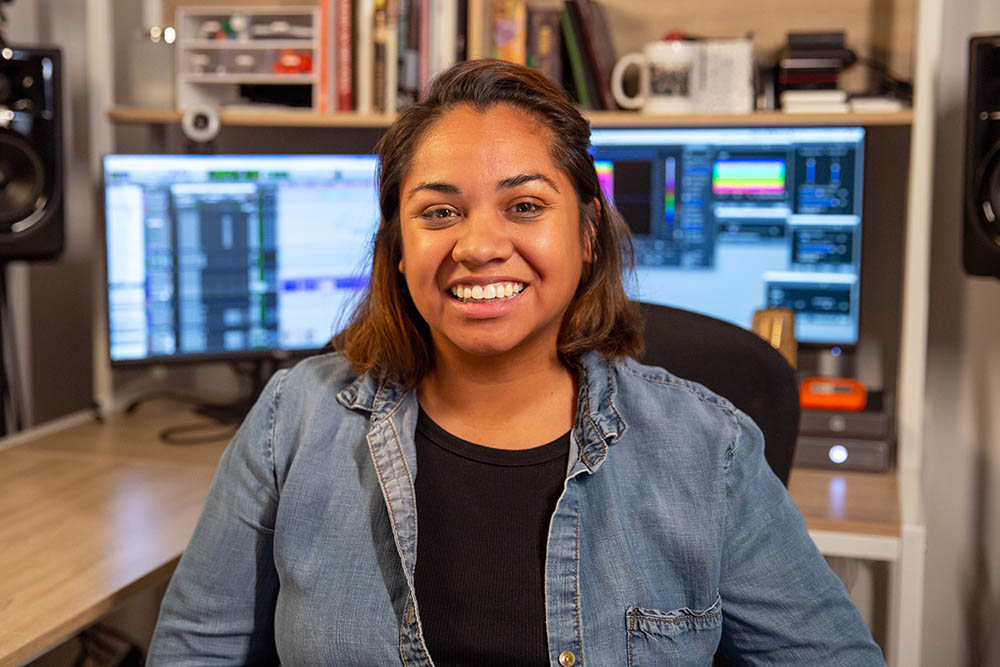
Meet Ailene Roberts '09
- Job Title & Employer
- Dialogue Editor, Supervising Re-Recording Mixer, Freelance/Pacific Standard Sound
- Major/Program
- Film Production
- Hometown
- Chalfont, Pa.
- High School
- Central Bucks High School - West
- Now Living In
- Redbank, N.J.
- Hobbies & Interests
- My family (I have a two-year-old), pottery, ceramics, hiking and any way to get away from a computer.
"My advice to prospective students is to stay open to every opportunity and explore as many aspects of the industry as possible. It’s great to have ambitious goals and dream of becoming a director, writer, editor or filmmaker, but college is the perfect time to experiment, take risks and discover what truly excites you."
Highlight your professional experience since graduating from Point Park.
I've built my career in post-production sound with a focus on dialogue editing, contributing to several major film and television projects. Some of my most notable credits include "The Lord of the Rings: The Rings of Power" and "Venom: Let There Be Carnage."
Working on the "Venom" films was particularly significant because it gave me the opportunity to focus extensively on dialogue editing while working under renowned re-recording mixer Kevin O’Connell at Sony. It was an exciting milestone to know that my work was being reviewed and incorporated into such high-profile productions.
A key influence on my professional development was dialogue supervisor Erin Oakley, who mentored me early in my career. While I initially worked more in assistant roles, she encouraged me to sit alongside her, learn her process and take on dialogue editing projects of my own. Through that hands-on mentorship, I developed both the technical skills and confidence to pursue dialogue editing as my specialty.
Another important milestone was "Chemical Hearts," one of the first projects I supervised independently. Taking on that level of responsibility helped establish me as a professional in the field and marked an important step toward the larger-scale film and television work I continue to do today.
What were your key responsibilities as a dialogue editor on "The Lord of the Rings: The Rings of Power" series on Amazon?
My primary responsibility was managing and refining the production dialogue to ensure clarity, consistency and performance quality throughout the series.
Working under dialogue supervisor Steph Manning, who oversaw the extensive ADR process, I focused on identifying dialogue issues, cleaning tracks and preparing multiple versions of challenging scenes for the re-recording mixers. Because the series featured numerous accents, languages and dialects, part of my role involved evaluating dialogue intelligibility from an audience perspective while remaining sensitive to character and performance choices.
Once the core dialogue editing was complete, I also assisted with integrating automative dialogue replacement (ADR) and group ADR, helping support the enormous volume of replacement dialogue required for a production of that scale. Collaborating closely with the mixing team, I ensured they had the best possible dialogue options to create a clear and immersive viewing experience.
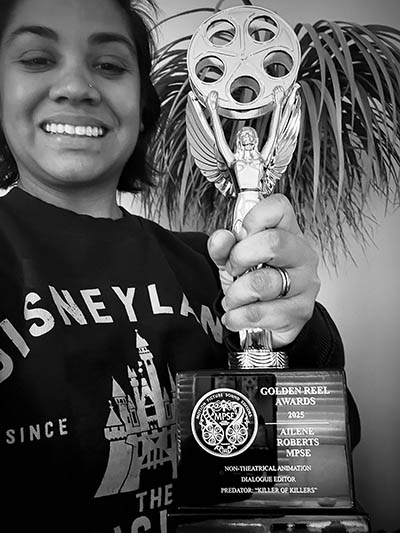
You recently won a Golden Reel Award for your work. Tell us more about that.
The Golden Reel Awards are presented by the Motion Picture Sound Editors (MPSE) and are among the highest honors in the sound industry because recipients are selected by their peers — fellow sound professionals who understand the creative and technical challenges behind the work.
Receiving a Golden Reel was especially meaningful because it represented recognition from colleagues who know firsthand what it takes to bring a project to life.
The award was for an animated project that required an unconventional and highly collaborative workflow. Unlike many established animation productions where processes are already well defined, this project involved developing new approaches and solving challenges in real time alongside the directors, editors and sound team. The experience demanded creativity, flexibility and close collaboration throughout production and post-production.
For me, the award was validation of the tremendous effort the entire team invested in the project and recognition of the unique challenges we overcame together. It was also particularly rewarding to be one of three dialogue editors on the project, all of whom were women — a professional experience that was both inspiring and memorable. Having our work acknowledged by the sound community made the achievement even more special.
What do you enjoy most about your job and why?
What I enjoy most about my job depends on the role I’m filling. As a supervising dialogue editor, I love the collaborative aspect of filmmaking. Working directly with directors, editors and mixers allows me to contribute creatively to the storytelling process, whether we’re discussing ADR needs, refining performances or solving challenges within a scene. The best directors create an environment where every team member has a voice, and I appreciate being part of those conversations. It’s rewarding to know that my perspective is valued and that I can help shape the final product alongside other creative professionals.
As a dialogue editor, the satisfaction comes from a different place. Dialogue editing is like solving a giant puzzle — carefully analyzing recordings, removing unwanted noise, improving clarity and finding creative solutions to technical problems. Every scene presents a new challenge and there is a real sense of accomplishment in uncovering the best way to make a performance shine. I enjoy both sides of the job: the collaboration and leadership that come with supervising, and the focused, detail-oriented problem-solving that comes with editing. Each role requires a different skill set, which keeps the work engaging and rewarding.
What advice do you have for prospective students?
Try different roles, even the ones that seem outside your comfort zone, because every experience helps you develop new skills and a broader understanding of the filmmaking process. The film industry is far larger than most people realize, with countless creative and technical career paths available. The more willing you are to explore, the more likely you are to find the niche that fits your talents and passions — and the better prepared you’ll be for a successful career.