Alumni and Current Students Share Advice, Personal Journeys at Literature, Culture and Society Career Summit Monday, March 2, 2026
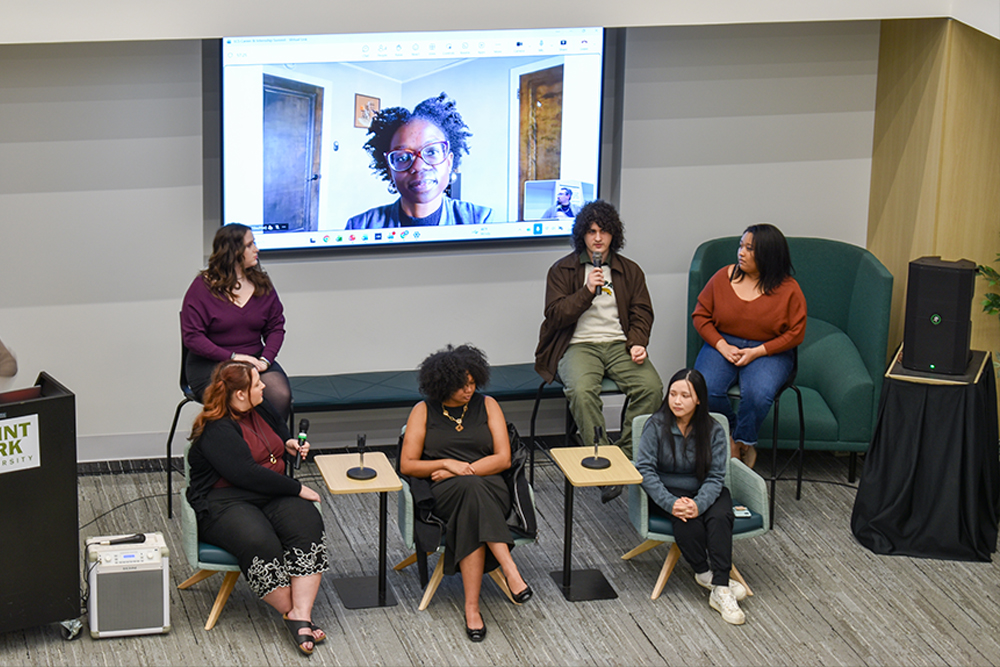
Current students and alumni spoke at the Sixth Annual Literature, Culture and Society Career and Internship Summit on Feb. 25, 2026. Presenters shared their personal journeys through the job market and gave insight into the exciting projects they now get to be a part of each day. Photo by Nico Rich '29.
“Point Park has a strong liberal arts legacy, and I believe our department has real potential to become a destination for students interested in publishing and literary careers.”
Point Park University students and alumni formed a panel to share their experiences with finding jobs and internships during the recent Literature, Culture and Society Job and Internship Summit on Feb. 25, 2026.
Meeting in the Professional Career-Readiness Center, the panel discussed the variety of job options available to Literature, Culture and Society (LCS) Department students and the importance of internships gained during undergraduate programs. In addition to the panel discussion, students got the chance to connect and showcase their Senior Projects at a networking session.
“As a soon-to-be graduate, I was excited to hear about their experiences after graduation and learn more about the paths they’ve taken,” said Charlie Hosek, a senior English major double-minoring in creative writing and education. “It feels like a valuable opportunity to build relationships and gain insight into potential next steps.”
For current students, a recurring discussion point was the support that faculty members provide on their journeys. As they build their networks, an important goal is to lay the groundwork for other Pioneers to follow in their footsteps.
Divine Eyth, a sophomore English major and human resources minor, helped start Pulse Literary Magazine to give her fellow students a platform to have their work published and to continue building Point Park students' expanding footprint.
“Point Park has a strong liberal arts legacy, and I believe our department has real potential to become a destination for students interested in publishing and literary careers,” Eyth said. “Throughout my undergraduate experience, I’ve been deliberate about choosing opportunities that align with my goals and coordinating closely with department leadership to shape a path that feels both rigorous and professionally relevant. I hope that by sharing what I’ve built, I can help other students think strategically about how they want their degree to serve them.”
One of the things that alumni panelists stressed was the diversity of job options a degree in English offers to students and the importance of marketing those skills as creatives. For Kidde Kokole ’18, her degree in English literature has helped her transition through roles in education, administration and now in research at the University of Colorado.
For researchers like Kokole, the complex problem-solving involved in her degree helped her become an invaluable part of her teams since graduation.
“My advice would be to find what you're passionate about and pursue that,” Kokole said. “If you're not sure what you're passionate about, explore what interests you or piques your curiosity. An English degree sets you up nicely with skills that any employer finds worthwhile. Talk to people in the fields you're interested in and ask about their experiences. Don't be afraid to reach out because everyone started from somewhere.”
Kelly Le, another English major who graduated in the class of ’24, says she uses her classroom experience to help identify how some language can be misinterpreted. Now working as a Software Documentation Writer for MSA Safety, she uses her skills to make things clear for her readers.
As this is yet another route LCS students can take, Le says that summits like these are useful tools for exploring different career trajectories and getting a leg up on networking in a very diverse field.
“My advice is to build a relevant portfolio for the job you want, and find paid internships through network connections, Handshake, LinkedIn and similar platforms,” Le said. “For UX and technical writing specifically, most internship and job roles require relevant writing samples. The best way to create some samples is to find an app or physical product (e.g., an espresso machine) with bad or nonexistent documentation, and either write a tutorial or write about key product features. As for networking tips, just be candid and don't be afraid to reach out to people, because that’s how I got some wonderful interview opportunities.”
Taking those opportunities was also stressed by Cloe Loosz ’25, who now uses her degree in creative writing at the Carnegie Museums as the assistant manager of engagement. By polishing skills before graduation, Loosz used her degree and double minors in public relations, advertising and social media and gender studies to showcase her creative mind.
“My creative writing degree gave me a unique advantage in my job hunt,” Loosz said. “Not only did I gain skills in various genres of creative writing during my undergraduate experience, but I also developed skills in professional writing fields such as grant writing. It also trained me to be a naturally creative strategist. In my current position, I have proposed and executed innovative ideas and solutions during event planning processes and while updating internal processes and procedures.”
Using her experiences to create well-communicated, equitable ways to engage donors, Loosz is helping ensure the museums can continue to thrive. It’s the skills gained from honing that creativity that she says sets her and other Point Park students apart from the competition.
“Anyone can follow directions, but it takes a unique mind to be a creative thinker and storyteller,” Loosz said. “That is what allows me to be uniquely marketable in my field.”