
Faculty Q&A: Dora Ion, Ph.D., Brings Her Real World Experience to Prompt Philosophical Discussions in the Classroom Thursday, July 2, 2026
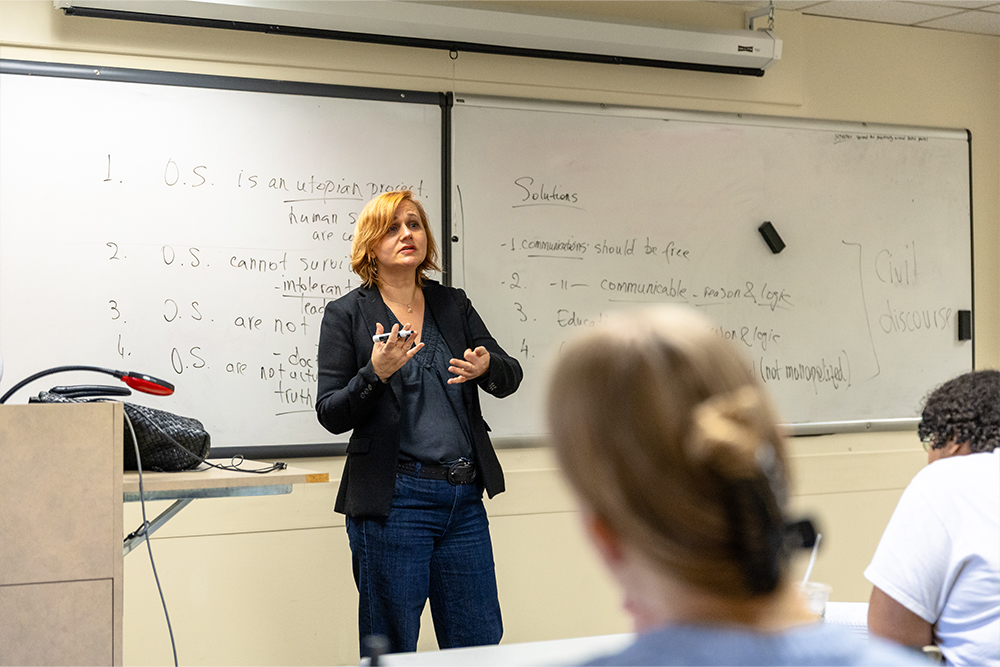
Dora Ion, a professor at Point Park University, teaches a class to students on political theory.
"I greatly admire the students here because most of them work, at least part-time, to sustain themselves. I personally think that's very difficult: balancing so many expectations so early in adulthood, setting your priorities straight and reading the assigned readings. It takes a certain level of maturity to do that."
In a constantly evolving political landscape, it takes professors like Dora Ion, Ph.D., to help instruct the next generation of political analysts and leaders. As the coordinator of the political science and legal studies programs at Point Park University, her classes in the Literature, Culture and Society department are often thought-provoking discussions informed by real-world experiences.
In the Q&A and video below, Ion highlights the value of Point Park's programs and what sets our students apart from others in the region and across the globe.
What do you do around Pittsburgh for fun?
I take delight in Pittsburgh's cultural diversity, especially in the way it feels very much like a small town in a big city. I enjoy the unique character of Pittsburgh's neighborhoods. I like a particular cafe in Squirrel Hill, the Arts Festivals in Mellon Park and Shady Side and the Three Rivers Arts Festival here in downtown. But more than anything, I enjoy shopping for ethnic foods in the street markets.
I also enjoy taking long walks along the rivers and on the bridges. I walk across a bridge to get to the university every day!
What do you enjoy the most about teaching at Point Park?
There are three main things that I enjoy. First, I enjoy a small class format. I think this facilitates in-depth discussions and dynamic conversations with the students. It helps all students participate in conversations, but I also think the format fosters a very genuine mentorship-like dynamic in the classroom, which is rare. I don't think other universities have the opportunity to build a true connection with students, which usually happens outside the classroom during office hours and advising sessions.
I also really like my colleagues! I think we have at the LCS Department a very friendly and collegial environment, which was something that I appreciated from the very beginning when I started teaching at Point Park.
Lastly, many of my students, especially in the lower-level classes, are artists. I think that's great! I think they come already equipped with compassion, but even more than compassion, with empathy. They also have a penchant for soul searching, which is a great asset to have when you sit in a human rights or political theory class.
Why should students choose Point Park?
Students should choose Point Park for its small classroom format, which offers a better chance of academic success through close supervision and connections with teachers.
We also have a very diverse student body that is really awesome at Point Park. There is a good vibe stemming from the diverse group of students that we get. We have artists, commuters, athletes and students of all colors and orientations, which I think is really great.
The proximity to the cultural district, to businesses and corporations with headquarters here, and to public institutions. It's easy for students to work in these places, and also show up for classes. It's easier for them to also get internships and go for interviews upon graduation.
What are your department's goals?
We continue to provide a wide range of courses that are high impact and relevant, to create and continue teaching courses like the history of Pittsburgh, the history of civil rights, environmental justice courses, as well as courses with a global learning dimension like human rights, nationalism, the South African anti-apartheid movement and revolutions and many more important topics.
We also regularly organize a series of events through the LCS Department. There is a writer-speaker event, and we organize student debates every semester. My department also organizes, at the end of each academic year, a student research symposium, so our students have the chance to present their work in the humanities and social sciences in a wide range of formats, including paper presentations, posters, roundtables, poetry readings and more.
What is the advantage of attending a university like Point Park in Downtown Pittsburgh?
I think the main advantage would be cultural immersion, the fact that we are located here, so close to cultural events. It makes learning a really valuable and culturally rich experience. Also, everything happens here in downtown; there are so many public events, political and social speeches at the nearby universities. Students really have a chance to choose what they like and do what they want, and, as I said before, the proximity to the offices and headquarters of businesses, including law firms and public institutions like the court, makes this convenient for students.
Can you share a teaching moment from your time at Point Park that felt special?
I learn every day from teaching my students. I greatly admire the students here because most of them work, at least part-time, to sustain themselves. I personally think that's very difficult: balancing so many expectations so early in adulthood, setting your priorities straight and reading the assigned readings. It takes a certain level of maturity to do that.
So, there's also a sense of urgency in approaching the learning material. I don't think I would have had a similar experience in Europe, as the average college student there doesn't typically work during their studies, and learning doesn't shape their identity or approach to the material in the same, practical, ready-for-life manner.